PROPHET MUHAMMAD BIRTH STORY AND ITS LASTING MEANING
The birth story of Prophet Muhammad, peace be upon him, is one of the most significant events in Islamic history and in the spiritual memory of more than a billion Muslims around the world.
It marks the arrival of the final messenger in Islam, a figure whose life, teachings, and moral example continue to shape faith, ethics, law, and civilization.
For readers searching for the prophet mohamed birth story, it is important to approach the subject with historical sensitivity, religious respect, and clear explanation.
This article presents a detailed, formal, and blog-style exploration of his birth, family background, historical context, signs mentioned in Islamic tradition, and the broader significance of the event.
It also places the topic within a wider cultural and historical framework to help modern readers understand why this moment remains so deeply meaningful.
The Historical Setting of Prophet Muhammad’s Birth
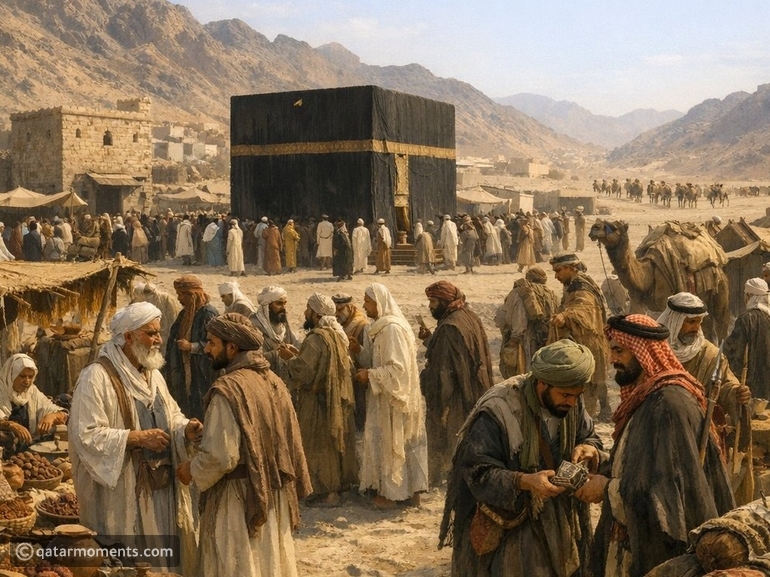
Prophet Muhammad was born in Makkah, a major trading and religious center in the Arabian Peninsula, during a period often described as the Age of Ignorance, or Jahiliyyah, in Islamic tradition.
This was a time when tribal identity strongly shaped social life, trade routes connected Arabia to Syria and Yemen, and the Kaaba in Makkah drew pilgrims from many tribes.
Historians generally place his birth in the 6th century CE, with many Islamic sources associating it with the Year of the Elephant.
That year is remembered for the failed campaign of Abraha and his army against the Kaaba, an event mentioned in Islamic tradition and linked to the protection of the sacred House.
The birth of the Prophet in this environment is seen by Muslims as the beginning of a transformative moral and spiritual renewal.
Makkah as a Birthplace of a Future Messenger
Makkah was not merely a desert settlement; it was a city of commerce, pilgrimage, and tribal alliances.
Its strategic location made it an important point for caravans traveling across the Arabian Peninsula.
Families such as Quraysh, the tribe of the Prophet, held social prominence because of their role in managing pilgrimage and trade.
In this setting, the Prophet’s birth carried social meaning as well as religious significance.
Later Islamic history would show that a person born in a relatively modest family could become the central moral force in a vast civilization.
The Family Lineage of Prophet Muhammad
Prophet Muhammad belonged to the noble Quraysh tribe, specifically the Banu Hashim clan, one of the respected branches of the tribe.
His father was Abdullah ibn Abdul Muttalib, and his mother was Aminah bint Wahb, both remembered with honor in Islamic tradition.
His lineage traces back through respected ancestors, and Muslims view his family tree as part of the honorable heritage of Makkah.
The social structure of the time emphasized lineage, and the Prophet’s ancestry placed him among a well-known and respected tribal line.
At the same time, his early life was marked by simplicity and hardship, which later became an important part of his moral authority and human example.
Abdullah and Aminah: Parents of Mercy
Abdullah, the Prophet’s father, passed away before his son was born, leaving Aminah to raise the child with care and dignity.
This fact is widely known in Islamic biography and contributes to the portrait of the Prophet as one who experienced loss early in life.
Aminah is remembered as a noble and virtuous woman, and her role in the Prophet’s birth story is deeply cherished by Muslims.
Many believers reflect on her patience and strength, seeing in her the dignity of motherhood under difficult circumstances.
Her place in the story highlights the human dimension of prophetic beginnings.
What Islamic Sources Say About the Birth
Islamic biographies and historical works describe the birth of the Prophet Muhammad as a blessed event accompanied by signs that indicated his special role.
These reports appear in classical sīrah literature, hadith collections, and later devotional works, though scholars distinguish between firmly established reports and later narrative expansions.
For believers, the essential point is that his birth was divinely favored and that it marked the beginning of a mission of guidance.
For historians, the sources must be read carefully, comparing reports, chains of transmission, and the context in which they were preserved.
This balanced approach helps readers understand both the devotional and historical dimensions of the prophet mohamed birth story.
The Commonly Mentioned Date of Birth
Many Muslims commemorate the Prophet’s birth on the 12th of Rabi al-Awwal, though other dates have also been reported in early sources.
This diversity is not unusual in early Islamic history, where exact dates were sometimes transmitted differently across regions and scholarly circles.
The use of the Islamic lunar calendar also means that the date shifts annually in the Gregorian calendar.
Because of this, discussions of the birth date often focus more on the meaning of the event than on calendar precision alone.
Regardless of the specific date preferred, the central spiritual truth remains the same for believers.
Signs and Narratives Associated with the Birth
Traditional Islamic accounts describe several signs associated with the Prophet’s birth.
These include reports of unusual light, blessings in the home of Aminah, and the sense that a great change had entered the world.
Some stories also mention the collapse of certain structures in distant lands or other symbolic occurrences.
Such accounts are often understood in devotional literature as signs of a new era rather than as ordinary historical records in the modern academic sense.
They express the idea that the birth of the Prophet was not a private family event alone, but a turning point for humanity.
The Symbolism of Light in the Birth Story
One of the most widely known motifs in the prophet mohamed birth story is the image of light.
In many Muslim communities, light symbolizes guidance, mercy, truth, and divine presence.
Reports of light are often read as poetic expressions of the Prophet’s future role as one who would illuminate hearts and societies.
This symbolism appears not only in devotional biographies but also in Islamic poetry, sermons, and popular teaching.
The theme of light is important because it connects the birth narrative to the larger message of revelation and moral awakening.
The Year of the Elephant and Its Significance
Islamic tradition connects the Prophet’s birth to the Year of the Elephant, remembered for the attempted attack on the Kaaba by Abraha’s army.
This event is part of the broader historical background of Makkah and is also reflected in Qur’anic memory through Surah Al-Fil.
Many Muslims understand the event as a sign of divine protection over the sacred sanctuary.
By placing the Prophet’s birth in that year, Islamic tradition creates a powerful narrative of preparation for a coming mission.
The symbolism suggests that the world was being readied for the birth of a messenger who would later restore monotheism and moral order.
Why the Year of the Elephant Matters
In historical storytelling, the Year of the Elephant functions as a calendar marker and a theological symbol.
It ties the birth of the Prophet to the protection of the Kaaba, which would later become central in Islamic worship.
It also reinforces the idea that the rise of Islam was not accidental, but part of a purposeful divine plan.
Modern readers often compare this to how foundational figures in other traditions are linked to notable historical moments.
In that sense, the birth story of the Prophet is both historically located and spiritually elevated.
Early Childhood After the Birth
After his birth, Prophet Muhammad was cared for in the customary manner of elite Arab families, which often included sending children to the desert for fostering.
This practice was believed to strengthen language, health, and character in a pure environment away from the city.
His foster mother was Halimah al-Sa’diyyah, whose household is remembered as being blessed after his arrival.
Islamic biographies describe her family’s difficult circumstances improving after taking the young Muhammad into her care.
These accounts reinforce the theme that blessing accompanied his presence from the very beginning.
The Role of Halimah al-Sa’diyyah
Halimah’s story is one of the most beloved parts of the Prophet’s early biography.
Tradition says her camel, livestock, and household prospered after she welcomed the child.
Such narratives are important in Islamic memory because they show the social impact of his life even before prophethood.
They also reflect a common moral pattern in prophetic biographies, where divine blessing appears through humility and service.
For many readers, Halimah’s role illustrates how ordinary people can become part of sacred history.
The Death of His Father and Mother
Prophet Muhammad’s early life was shaped by the loss of his father before birth and the later passing of his mother when he was still a child.
These experiences gave his life a profound human dimension and are often cited as reasons for his empathy toward orphans, widows, and the vulnerable.
Islamic teachings later placed strong emphasis on caring for orphans, and his own life served as a powerful example of that duty.
Historical accounts describe how he moved through guardianship under his grandfather Abdul Muttalib and then his uncle Abu Talib.
His early hardships became part of the moral fabric of his mission.
Lessons from Early Orphanhood
The Prophet’s orphanhood is not merely a biographical detail; it is central to understanding his compassion.
Many Muslim scholars explain that personal suffering often deepens a person’s ability to comfort others.
In the Prophet’s case, the experience of losing parents at a young age may have shaped his sensitivity to neglect and injustice.
Modern psychological studies also often show that individuals who face early adversity can develop strong resilience and empathy when supported by caring communities.
This offers a useful lens for understanding how the Prophet’s early circumstances contributed to his later leadership.
The Broader Spiritual Meaning of His Birth
The birth of Prophet Muhammad is not treated in Islam as an ordinary historical milestone alone.
It is viewed as the beginning of a mercy for the worlds, as reflected in the Islamic understanding of his later mission.
His coming is associated with guidance, justice, compassion, and the restoration of pure monotheism.
For Muslims, the birth story represents hope, renewal, and the continuity of divine guidance throughout human history.
This is one reason the topic remains central in sermons, books, and educational programs across the Muslim world.
Mercy as a Central Theme
One of the most repeated descriptions of the Prophet in Islamic teaching is that he was a mercy.
This idea helps explain why his birth is celebrated as more than a private family event.
His life would later influence law, ethics, family life, business conduct, and social justice.
In many Muslim communities, the birth story is used to teach children about gratitude, humility, and reverence for prophetic history.
That educational role has made the topic relevant across generations.
How Scholars Approach the Birth Story
Islamic scholars typically approach the Prophet’s birth story through a combination of reverence, textual analysis, and historical evaluation.
They examine sīrah works, hadith reports, and classical biographies to determine which details are strongest in evidence.
At the same time, they recognize that devotional storytelling has long played a role in preserving collective memory.
This means that some elements of the story are presented as spiritually meaningful even when their historical certainty may vary.
Such a method allows the tradition to remain both respectful and intellectually serious.
History, Devotion, and Interpretation
In academic studies of early Islam, scholars often distinguish between historical reconstruction and religious tradition.
For example, a historian may note that some birth details are transmitted with varying strength, while a believer may focus on the spiritual lesson carried by the narrative.
Both perspectives contribute to a fuller understanding when handled responsibly.
This is especially important for readers seeking accurate information about the prophet mohamed birth story in English.
Careful interpretation prevents confusion and improves trust in the material.
Prophet Muhammad’s Birth in Muslim Culture Today
Across many Muslim-majority societies, the birth of Prophet Muhammad remains an important religious occasion.
Communities hold gatherings, recitations, lectures, and charitable events to honor his memory.
These observances vary by region and school of thought, but they share a common purpose: remembering the Prophet’s life and values.
For many families, telling children the birth story is a first introduction to Islamic identity and ethics.
In this way, the story continues to live not only in books but in homes, mosques, and classrooms.
Educational Use in Families and Schools
Teachers and parents often use the birth story to explain key Islamic concepts such as mercy, patience, gratitude, and trust in God.
It also helps children connect abstract beliefs to a real historical figure whose life can be studied and admired.
In many educational settings, narrative learning is considered effective because it improves memory and emotional engagement.
That is one reason prophetic biography remains a powerful teaching tool in religious education.
The story of his birth creates a foundation for understanding the rest of his life.
Why the Birth Story Remains Relevant Today
The prophet mohamed birth story continues to matter because it speaks to universal human concerns.
It addresses themes of family, loss, blessing, leadership, and purpose.
It also shows how a person born in humble circumstances can become a source of global moral transformation.
In an age when many people search for meaning and ethical guidance, such narratives remain powerful and relevant.
They offer not only historical information but also a model of hope rooted in faith.
Modern Reflections on an Ancient Story
Modern readers often look for stories that combine authenticity, inspiration, and practical wisdom.
The birth of the Prophet provides all three when read within the Islamic tradition.
It encourages reflection on how compassion can emerge from hardship and how purpose can grow from obscurity.
It also reminds readers that history is shaped not only by armies and empires, but by moral vision and spiritual leadership.
That is why the story continues to be studied, taught, and remembered around the world.
Common Questions About the Birth of Prophet Muhammad
Many readers ask when the Prophet was born, where he was born, and what signs surrounded his arrival.
These questions are natural because the event is so central to Islamic faith and culture.
They also reflect a desire to understand the Prophet as both a historical figure and a spiritual guide.
While exact details may vary in some sources, the major outlines are consistent across Islamic tradition.
The birth took place in Makkah, in the Banu Hashim household, and it marked the beginning of a life that would transform the world.
Key Facts Often Sought by Readers
He was born in Makkah, in the Quraysh tribe. His father was Abdullah and his mother was Aminah. Many Muslims commemorate his birth in Rabi al-Awwal. His early life included orphanhood and foster care. Islamic tradition associates his birth with signs of blessing and divine favor.The Lasting Legacy of His Birth
The birth of Prophet Muhammad is remembered because of what followed it: revelation, moral reform, community building, and a lasting spiritual civilization.
His early life helped shape his character, and his character became the foundation of his prophetic mission.
For believers, every detail of his birth story carries meaning, from the lineage of his family to the care he received as an orphaned child.
For students of religion and history, the account offers insight into how sacred biography functions in Muslim thought.
Its enduring power lies in the combination of faith, history, and ethical inspiration.
What the Story Teaches the Reader
The story teaches that greatness can begin in humble places.
It teaches that hardship does not prevent divine purpose.
It teaches that mercy and leadership can emerge from loss and vulnerability.
It also teaches that history is shaped by people who carry moral conviction with patience and sincerity.
These lessons help explain why the Prophet’s birth remains one of the most cherished subjects in Islamic literature and devotion.
Expanded Reflection on the Prophetic Beginning
When readers study the prophet mohamed birth story, they encounter more than an account of an infant born in Makkah.
They encounter a narrative that connects family, faith, history, and destiny in a single sacred arc.
The early signs described in tradition may be read differently depending on one’s method of study, but their message is consistent: a new chapter in human guidance had begun.
That message has endured for centuries because it speaks to deep human hopes for justice, compassion, and spiritual direction.
In this sense, the birth story is not only a memory of the past but also a living source of reflection for the present.
Final Reflections for Contemporary Readers
For contemporary audiences, the story can be appreciated on multiple levels.
It is a religious account for Muslims, a historical subject for researchers, and a moral narrative for anyone interested in leadership and human development.
It also demonstrates how memory is preserved through texts, practices, and communal storytelling.
Whether one studies it for faith, education, or historical interest, the birth of Prophet Muhammad remains a profound and influential event.
Its message continues to invite readers toward understanding, respect, and thoughtful reflection.
This article was posted on qatarmoments
2026-08-25T12:33:59Z